
Narayan Prasath · 2025-01-01
How to Turn Reddit Rants and Search Gaps into High-Resonance Authority Content

Jul 17, 2025
|
Narayan Prasath
Signal Triangulation 101: Turning Reddit Rants and Search Gaps into Authority Content
How mining genuine community frustrations can reveal content gold. Learn to gather signals from social “rants,” map them to low-competition, high-intent keywords, and craft authoritative articles in your brand’s tone of pragmatic optimism.
Introduction
Content marketers and growth hackers often face a daunting question: what should we write about that truly resonates? Too often, brands churn out random topics that get lost in the noise. But what if the “noise” itself contains signals – clear voices of your audience flagging exactly what they care about (and can’t find answers to)? This is where signal triangulation comes in, leveraging AI workflows to better analyze community feedback. Think of it as using multiple coordinates – the raw frustrations aired on forums, plus data on search demand – to pinpoint high-impact content opportunities. By the end of this guide, a beginner will understand how to transform a late-night Reddit rant or a Hacker News complaint into an SEO-friendly, authority-building article. We’ll cover why social media rants are predictive data (not just chatter), a step-by-step workflow builder to mine and validate these ideas, tips for crafting the content in your brand’s voice (with a narrative that grabs attention), and even a mini case study of one rant turned into thousands of organic visits. Let’s dive in by rethinking how we view those online “rants.”
Social Rants: Not Noise, But a Predictive Dataset
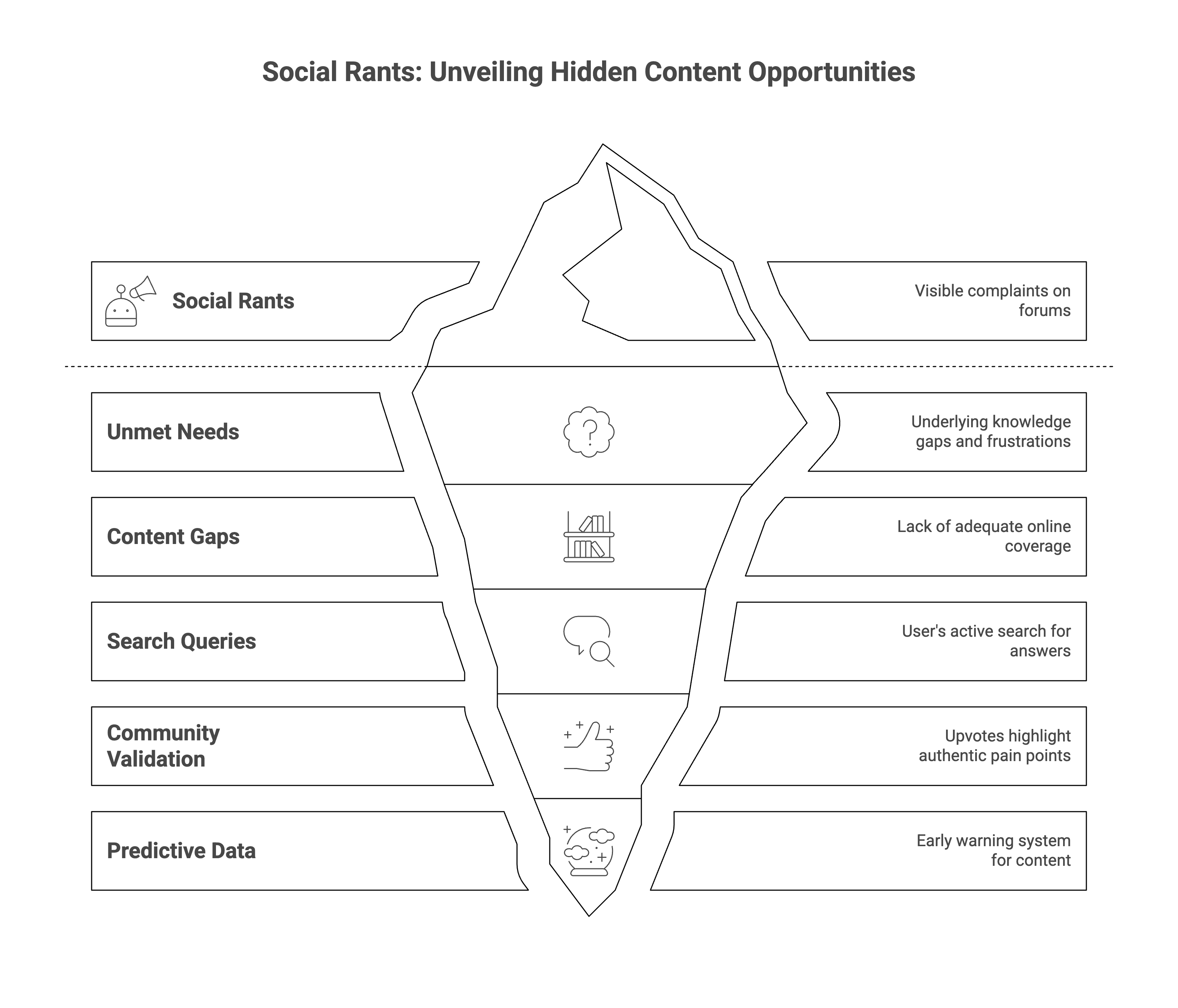
On the surface, internet forums and social platforms can look like chaotic hives of complaints, grievances, and random musings. But for a content marketer with the right mindset, those very rants are a treasure trove of insight. Why? Because each upvoted complaint or impassioned thread often signals an unmet need or knowledge gap that many others likely experience. In fact, marketers have found that by analyzing subreddit discussions, it’s easy to identify “ content gaps” – areas where there’s strong consumer demand for information but a lack of adequate coverage elsewhere online . In other words, frequent frustrations voiced in communities often point to topics that should exist on blogs or help centers but don’t (or exist in poor quality).
Even Google has caught onto this trend. The search engine now frequently surfaces forum discussions in its results, recognizing a thirst for the authentic answers found in user-generated content . One analysis showed that forums (especially Reddit) appeared on page 1 for 77% of 10,000 search queries tested – a striking validation that what people rant or ask about in forums is often exactly what many are searching for on Google. It’s not “noise” at all, but an early warning system for content creators. Social rants are effectively a predictive dataset indicating tomorrow’s high-intent keywords and questions.
Importantly, forums like Reddit and Hacker News have democratic voting that filters the wheat from the chaff. The most upvoted posts and comments – often highly upvoted rants or “I wish someone would explain X” threads – highlight authentic, widely-felt pain points. The community literally votes these signals to the top. As one content gap analysis noted, “the posts and comments with the most upvotes are ones hitting on authentic knowledge gaps, helpful advice or ideas aligned to community interests.” In sum, if dozens of founders on Hacker News complain that a certain API lacks decent tutorials, or hundreds of Redditors upvote a rant about a confusing new regulation, you can bet there’s an audience hungry for content addressing it.
Signal triangulation means we don’t just stop at “this Reddit thread is trending.” We combine that social signal with data from search engines (and sometimes other sources like Q&A sites) to confirm: Is this frustration also reflected in search queries? Are people actively looking for answers? When a real user problem intersects with a search gap, you’ve found a golden content opportunity. In the next section, we’ll outline a step-by-step workflow to systematically find these opportunities – turning community noise into a content roadmap using automation tools and intelligent workflows.
Workflow: From Raw Complaints to SERP Opportunities
So, how do we actually do this “mining” of social frustrations and mapping to search-friendly topics? Below is a practical workflow – a step-by-step process – that you can follow (or even automate) to go from raw rant to refined content idea:
-
Scrape & Gather Community “Signals”. Start by collecting real user discussions from platforms relevant to your industry. This could mean crawling Reddit threads in specific subreddits, scanning Twitter or LinkedIn threads, Product Hunt or Hacker News comments – wherever your target audience vents or asks questions. You can do this manually (browsing top posts of the week, sorting by controversial or Q&A threads) or use tools that automate social listening. For example, Reddit keyword alert tools like Pulse for Reddit can track mentions of your chosen keywords and flag high-value conversations (e.g. a thread where someone is asking for a solution your product offers) . The goal here is to compile a raw list of pain points and questions people are actively expressing. Don’t worry if it’s messy – you might end up with a spreadsheet of dozens of complaints, questions, or feature requests in users’ own words, which can serve as valuable insights for your growth marketing strategies.
-
Cluster and Synthesize the Complaints. Next, make sense of that raw data by grouping similar issues together. Often, you’ll notice patterns: five different Reddit users across separate threads essentially complaining about the same underlying problem. Perhaps “CRM X’s export feature is too slow” keeps coming up, or multiple founders on HN rant about “no straightforward guide to implementing GDPR for a SaaS startup.” Group these related pain points into clusters. Each cluster represents a broader theme or topic that might be worth addressing. Modern AI can assist hugely in this step – you can feed the list of complaints into a language model to automatically categorize them by similarity. In fact, research has shown that using LLM agents for clustering can produce more human-interpretable topic clusters than classical algorithms. So an AI agent might quickly summarize “these 12 comments all relate to difficulties in onboarding new remote hires,” which you might label “remote onboarding challenges.” The clustering step distills the noise into a few clear signals. You might end up with, say, 5–10 themes that keep recurring. Prioritize clusters that seem especially painful or frequent (high volume of mentions or upvotes). Pro tip: also note the exact phrasing people use – those words might be valuable keywords later.
-
Identify Low-Competition, High-Intent Keywords. Now it’s time to bring in the search data and triangulate. Take each pain-point cluster and brainstorm how someone might search for it on Google. For example, if the cluster is “frustration with slow CRM export,” a user might search “How to speed up [CRM name] data export” or “[CRM name] export takes too long.” Use keyword research tools (Google Keyword Planner, Ahrefs, SEMrush, AnswerThePublic, etc.) to check these and related queries. What you’re looking for are search gaps: queries that have a meaningful search volume (even a few hundred a month is fine if highly targeted) but for which current top results are weak or not directly addressing the question. Oftentimes, these will be longer-tail keywords or very specific questions that larger competitors haven’t bothered to write about. This is your opportunity. As an example, one marketer discovered the phrase “simple smartphones for arthritis” being used on a forum – it turned out to have ~3,000 monthly searches and very low competition, making it a viable content target . It was an underserved query basically extracted from user discussions. Similarly, cross-check your clusters: does each correspond to a question people ask online? If yes, how competitive are those SERPs? If current results are scant or filled with forum links, that’s a great sign. Industry research backs this approach: user critiques and areas they want more information on are signs of content gaps . You’ll want to prioritize topics that have solid search demand but lack comprehensive answers online, because “those gaps present opportunities to build comprehensive answers to open questions” . In practice, you might narrow your list to a handful of high-intent, low-competition keywords that align with the genuine problems seen in step 1. (It’s literally quality over quantity here – a deeply relevant article that nails a specific frustration can outperform a generic post on a broad term.)
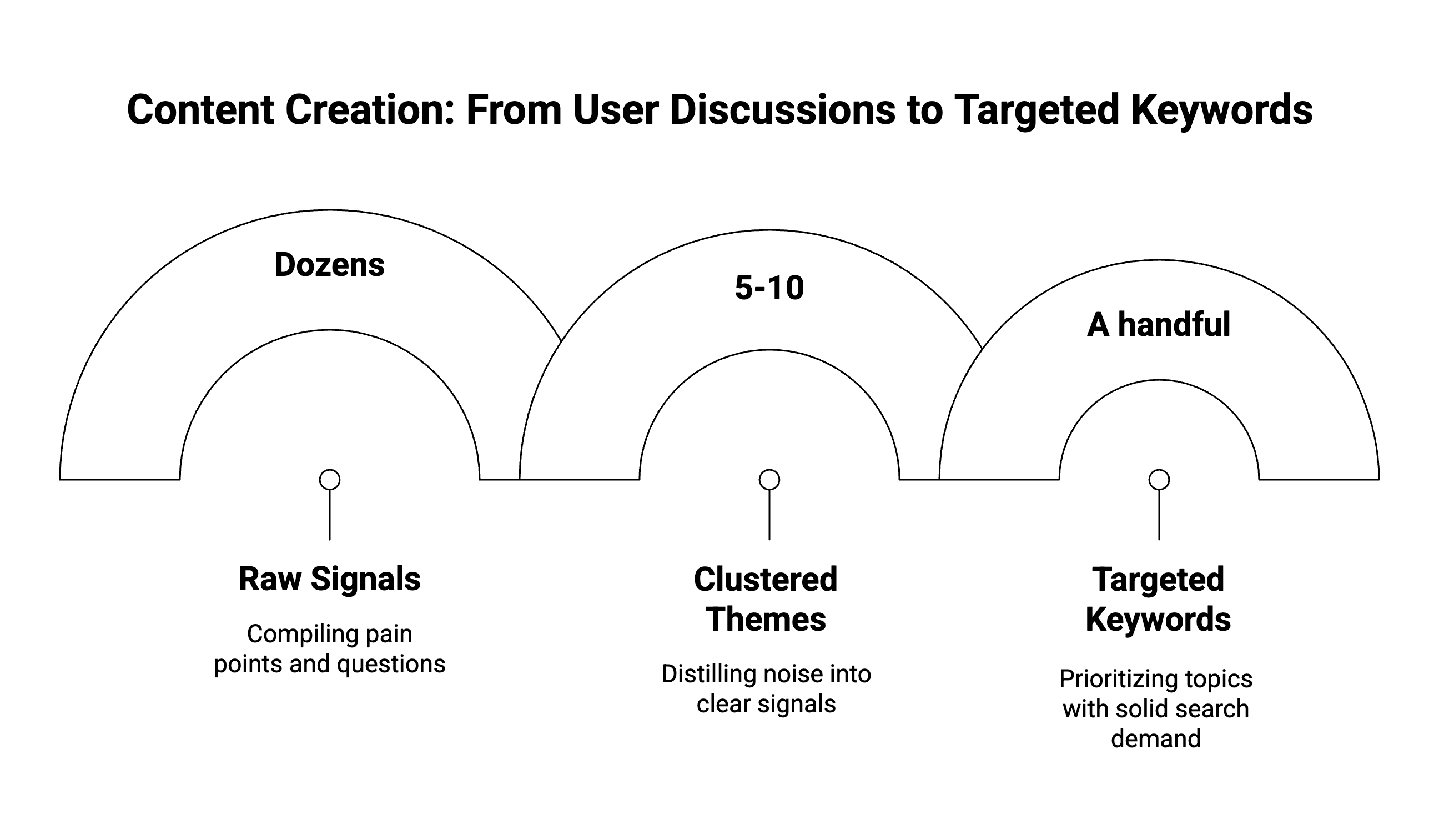
At this point, you’ve triangulated the signal: a real user problem and a search query void. To visualize the workflow, imagine a simple pipeline: Scrape forums → “Complaints about X” → cluster into themes → “Theme Y has 10 people complaining” → check Google → few good results on Y → Eureka, a content idea! You can even repeat this process regularly as part of your content strategy, ensuring you’re always riding the wave of emerging discussions rather than guessing in a vacuum.
Before moving on, it’s worth noting that you don’t have to do all of this manually. There’s a growing ecosystem of AI-driven tools and agents that can accelerate this workflow. In fact, some growth teams string these steps together using no-code AI workflow builders. For instance, Metaflow (an AI automation platform) highlights “SEO content workflows” as a core use case of its no-code agent builder . You could set up an agentic workflow that monitors Reddit or Hacker News for keywords, uses AI to cluster and summarize the chatter, then perhaps even queries a keyword API to output a list of content gap opportunities – all automatically. Whether or not you automate it, the outcome is the same: a validated list of content topics sourced straight from real frustrations and positioned where you can realistically rank and add value.
Crafting the Piece: Brand Voice, Headlines, and Narrative Arc
Identifying a juicy topic is half the battle; now you must turn that raw idea into a compelling piece of content that resonates with your audience and aligns with your brand’s identity. The key here is to maintain your brand’s tone (e.g. pragmatic optimism), while directly addressing the pain point in a way that feels both empathetic and authoritative.
Establish Brand Voice Guardrails: Before you start writing, clarify the voice and attitude your brand should convey. In our case, the goal is a tone of pragmatic optimism – that is, acknowledge the challenges frankly but maintain a solution-focused, hopeful perspective . This balance is crucial when dealing with “rant”-inspired topics. You want to validate the reader’s frustration (show them you understand why they’re upset or confused – you heard their rant!) yet also guide them to a positive outcome. For example, if the community complaint is “Our team’s Slack is a mess, impossible to find anything,” an article addressing it shouldn’t just say “Yes, Slack is chaotic” and stop there. It should quickly move into “here’s a pragmatic way to organize channels and use pins – it can get better.” Brand voice guardrails help ensure you don’t stray into negativity or, on the flip side, sugary optimism that ignores the problem. If your brand has a style guide, leverage it. Many companies formalize this: for instance, a brand might explicitly say their voice is “expert but approachable, with pragmatic optimism” (meaning they never condescend or catastrophize, always offering a balanced hopeful angle) . Keep those principles front and center as you write.
Headline Formulas that Hook: Your title is the first thing anyone sees – it needs to grab attention and promise to solve the exact problem the user has. A great approach is to mirror the language of the rant or question in the headline, then hint at a solution. For example: “ Tired of [Frustrating Problem]? Here’s How to Fix It for Good.” A headline like that immediately signals empathy (“tired of this? we get it”) and resolution (“for good”). Classic copywriting formulas shine here. You can use “how to” headlines (“How to Speed Up Your AI Workflows Without Losing Your Mind”), listicles (“7 Low-Tech Hacks to Solve [Problem]”), or even problem-solution statements (“Get Rid of [Problem] Once and For All”). In fact, the “Get Rid of [Problem] Once and For All” format is a tried-and-true formula in copywriting that directly taps into the reader’s desire to eliminate a pain point . Such a headline works because it identifies the painful problem and immediately offers hope of a permanent fix. When brainstorming titles, remember the mindset of the person who ranted initially – use words they used (for relevance) and appeal to the emotion they demonstrated. If a Redditor said “I hate that all project management tools do X,” a title might be “Hate How Project Management Tools Do X? Here’s a Better Way.” This both captures attention (since it echoes their own gripe) and implies you have the answer. Lastly, keep headlines straightforward and promise-focused; authenticity matters more than clickbait. (If the thread came from a community known for cynicism, like Hacker News, an overly hyped headline will turn them off – pragmatic optimism, not fluff.)
Narrative Arc and Structure: Once they click through, the article itself should flow in a way that keeps the reader engaged from intro to conclusion – essentially telling a story where the reader is the protagonist. One effective narrative arc for this kind of content is:
-
The Hook/Empathy Opening: Start by vividly describing the problem scenario – show you relate to the frustration. For example: “It’s 2 AM, and you’ve spent the last hour combing through hopeless forum posts because your new analytics tool won’t sync. Sound familiar?” Immediately, the reader nods along. You’ve agitated the problem just enough (like “yes, this is exactly my rant!”) while signaling you understand.
-
Pragmatic Transition to Solution: After empathizing, pivot to an optimistic tone: “The good news? You’re not alone – and better yet, there’s a fix to this.” Establish that the rest of the article will provide clear answers. This shifts the mood from commiseration to problem-solving.
-
Step-by-Step Resolution (Body): In the main body, deliver on your promise with well-organized, actionable advice or insights. Keep the structure logical: perhaps present the causes of the problem first (so the reader fully understands why it happens), then the solutions or best practices to resolve it. Continuing the story metaphor, this is where the hero (reader) acquires the “tool” or knowledge to overcome the challenge. Use subheadings liberally to make it scannable, and consider adding visuals or diagrams if it helps explain. (E.g., “At [YourCompany], we faced this exact issue, so we developed a no-code automation tool to tame it – here it is.”) By structuring the content as a journey from problem to solution, you ensure it speaks to the reader’s intent (they searched because they have this problem) and keeps them hooked through the answer.
-
Conclusion with Optimistic Future: End on a note of pragmatic optimism. After giving the solutions, reaffirm that the problem is solvable and their situation will improve. Maybe also zoom out: “Today’s rant-fueled pain point could be tomorrow’s smooth sailing, if you apply these fixes. And if all else fails, remember that every tool has its quirks – but with a bit of community wisdom, you can conquer them.” This wrap-up leaves readers feeling empowered. You might also invite further engagement (“Let us know if these tips worked, or if you have your own hacks – we’re listening!”) which shows you as a brand that continues to listen to user feedback.
Throughout the piece, maintain a consistent voice as discussed – knowledgeable yet down-to-earth, optimistic but never in denial about the issues. Use examples and anecdotes (maybe even referencing the original rant in a sanitized way: “One user on Reddit described it as ‘X’ – we’ve all been there.”). This not only gives credit to the community source but also adds authenticity and relatability.
Finally, ensure the content speaks in your brand’s tone of pragmatic optimism even in small details: if your brand avoids jargon, don’t suddenly throw in technical terms without explanation; if your brand values humor, include a light quip especially when describing the frustrating scenario (laughing with the reader, not at them). The goal is an article that feels like an empathetic expert taking the reader from “I’m frustrated and lost” to “I’ve got clarity and hope.” When done right, the reader almost hears your brand’s reassuring voice in their head, guiding them. This builds trust and authority – you’ve shown you not only understand their problem deeply but can also lead them to a solution.
Case Studies
To illustrate the power of this approach, let’s walk through some success stories that highlight effective growth marketing strategies.
Sam Parr, founder of The Hustle, leveraged insightful community signals by closely observing conversations on Reddit—particularly debates among Soylent enthusiasts about attempting a “30-day all-powder diet,” as well as frustration around Kindle plagiarism scandals within self-publishing subreddits. Responding directly to these signals, Parr authored highly resonant pieces such as “I lived on Soylent for 30 days” and an investigative exposé on Kindle plagiarism. These articles delivered remarkable outcomes, including half a million visits within the first week of The Hustle’s site launch, later accumulating millions of pageviews and newsletter subscribers. A pivotal mechanic that amplified these results was Parr’s strategy of sharing early article drafts back into the same subreddits, generating immediate community engagement, driving upvotes, and ultimately securing placement on Hacker News’ front page.
Groove HQ, a startup providing support tools, similarly harnessed community sentiment by observing founders openly venting about the tumultuous journey of scaling from “$0 to $100k MRR” on platforms like r/startups and Hacker News. In response, Groove launched a transparent blog series titled “SaaS Startup’s Journey to $100k MRR,” explicitly crafted around these pain points. This empathetic content strategy rapidly attracted a substantial audience, growing to 30,000 weekly readers and over 5,000 subscribers within five weeks. Remarkably, the blog emerged as Groove’s top customer acquisition channel, contributing approximately 65% of new customer logos. The effectiveness of this strategy hinged on addressing a specific frustration from each community thread and strategically mirroring exact phrases from user complaints in blog post titles, directly matching the original search intent and enhancing SEO visibility.
In another example, Soar Agency partnered with a dating-app client, pinpointing polarizing debates within r/dating and r/relationships communities around a particularly controversial matching concept. Leveraging these community signals, the agency seeded an engaging discussion and published a comprehensive explainer post addressing the community’s primary objections, which effectively utilized ai workflows for content optimization. This targeted approach yielded 18,335 visits within the first 24 hours, over 1,200 upvotes, and 109 comments. Moreover, it set the foundation for sustained keyword visibility through strategic SEO practices. The agency’s key mechanic here involved a deliberate thread-first launch strategy, fostering high-quality, brand-signaling backlinks and social traction prior to initiating on-page SEO optimization, ultimately enhancing their automation tools for content distribution.
By listening and acting quickly, you can create “authority content” that rides the wave of that demand with very little competition. It’s the opposite of shooting in the dark – it’s targeted content development with built-in product-market fit (or rather, content-market fit). As a bonus, because the article genuinely helps a frustrated audience, it tends to attract backlinks naturally (people share what solved their problem) and can keep ranking for a long time. All from one comment thread that another marketer might have dismissed as just a late-night rant! This approach exemplifies how no-code automation and AI-driven GTM workflows can revolutionize content marketing strategies, allowing businesses to adapt swiftly to audience needs and maximize their online presence.
Toolkit & Next Steps: Leveraging Agents and Automation
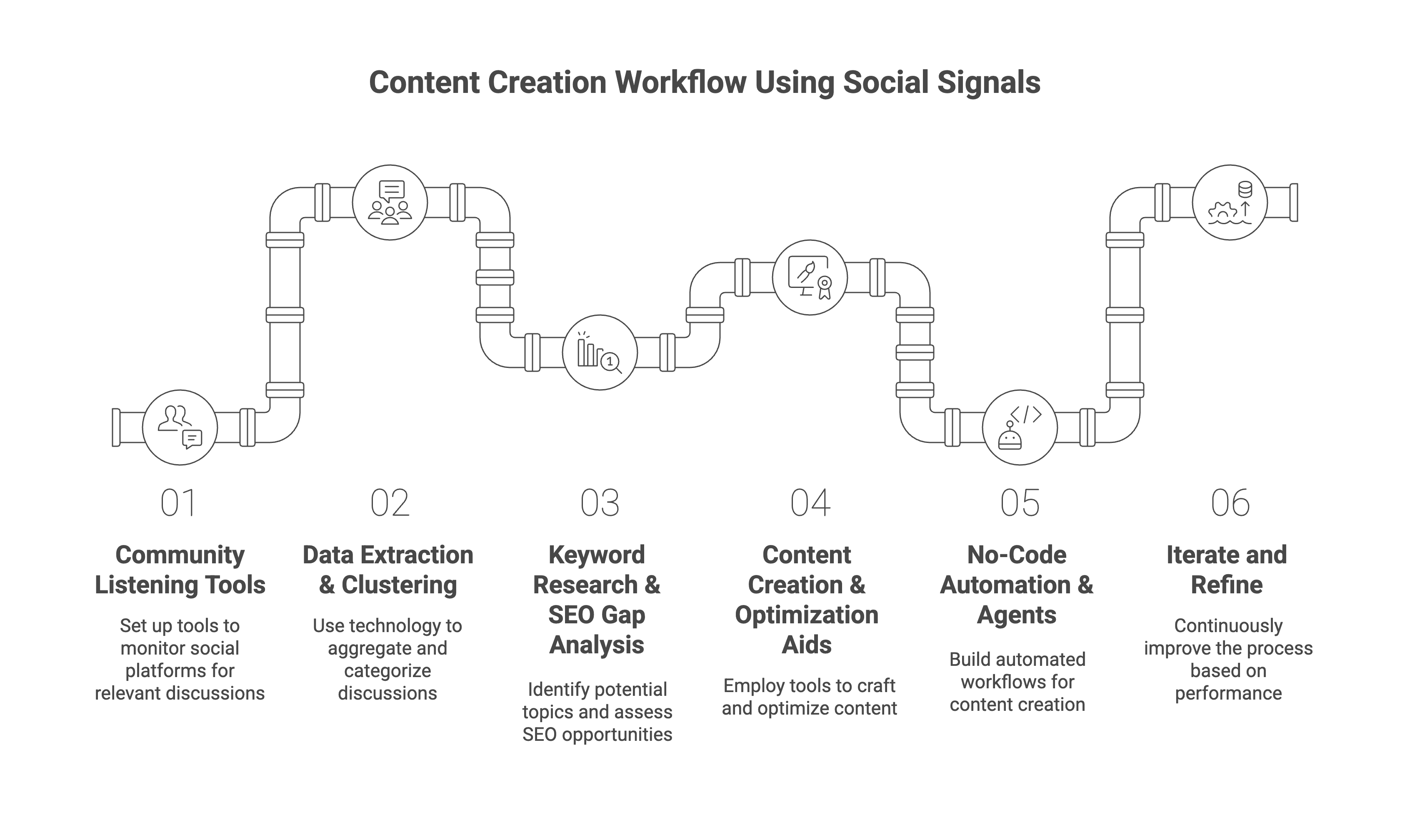
By now, you might be eager to try this signal triangulation approach yourself. To help you hit the ground running, let’s outline a quick “toolkit” and some next steps. These resources – a mix of tools, techniques, and tips – will make your workflow smoother and faster. In fact, many content marketers are beginning to employ AI workflows, including AI agents and automation tools, to streamline this entire process, so we’ll highlight how you can do that too.
-
Community Listening Tools: Set up a system to continuously listen for relevant rants or questions. Manually browsing Reddit or Hacker News works for starters, but consider tools that alert you automatically. For Reddit, tools like Pulse for Reddit can monitor keywords across subreddits and notify you of new threads, essentially flagging real-time “rants” for outreach opportunities . Twitter (X) and Slack communities might require their own monitoring – even a saved search or TweetDeck column can do. The goal is to never miss a high-signal post. If someone on a forum asks, “Has anyone figured out how to do X without problem Y?” – you’ll know right away and can log it.
-
Data Extraction & Clustering: To avoid drowning in anecdotal evidence, use technology to aggregate and cluster the discussions. Basic approach: export comments or thread titles containing your keywords (some platforms have APIs, e.g. Reddit’s API or unofficial ones). If you’re not code-shy, Python with libraries like PRAW (for Reddit) or the Hacker News API can fetch data. For clustering and analysis, you can utilize NLP libraries or, even easier, feed the text into an AI. As mentioned, large language models (LLM agents) can categorize complaints surprisingly well. For example, you might prompt an LLM with: “Group these 50 user comments into themes and list the main issue in each group.” This can save hours of manual sorting. Some no-code automation tools are emerging that let you visually do this: you import text data and the tool (with an AI backend) spits out clusters or sentiment analysis. The bottom line – leverage machines to find patterns in the noise fast. It’s like having a virtual analyst sift forums for you.
-
Keyword Research & SEO Gap Analysis: Arm yourself with at least one reliable SEO tool. Google Keyword Planner is free and gives basic volume and competition estimates. SEMrush or Ahrefs are paid options that provide more detail on difficulty scores, existing content, etc. (SEMrush, for instance, is widely used for keyword research and competitive analysis .) Don’t overlook simple tricks too: Google’s “People Also Ask” box or auto-suggest can reveal related queries. A handy free tool is AnswerThePublic, which visualizes questions people ask on search engines – great for expanding on a rant’s theme to ensure you cover all sub-questions. For each potential topic from your clustering step, run it through these tools. If you find that the topic has zero searches, you have to gauge if it’s still worth writing (maybe it’s ultra-niche now but growing). Ideally, you’ll find at least some long-tail queries. Use SEO tools to check the current top results’ quality. If forums like Reddit are dominating page 1, it’s a clue that there isn’t a stellar authoritative article yet (because Google wouldn’t show a Reddit thread if an excellent, relevant blog post existed). That’s your green light.
-
Content Creation & Optimization Aids: With topic and keywords in hand, you might employ some tools to help craft and optimize the content itself. For example, some marketers use AI writing assistants, like GPT-4, to generate a first draft or outline. If you do this, be sure to infuse your brand voice and review for accuracy – AI is a helper, not a replacement for your genuine expertise and tone. Tools like Grammarly or Hemingway can polish readability. For SEO optimization, plugins or platforms like Yoast (for WordPress) or SurferSEO can ensure you naturally incorporate the right terms and cover subtopics people expect. Essentially, treat the content creation process like any other high-quality article development, but boosted by these intelligent automation platforms. One neat idea: use the forum thread as inspiration for a FAQ section in your article. For instance, include a section “Q: “Does this method work on mobile?” – Community member on Reddit. A: [Your detailed answer].” This not only adds semantic depth (covering more questions) but also shows readers you really did listen to the community.
-
No-Code Automation & Agents: If you’re tech-savvy or have access to growth engineers, consider building an automated workflow for all the above. This is where tools like Metaflow, Zapier, Airops, or Bardeen come into play. For example, using a no-code tool, you might connect: Reddit API -> AI clustering -> Google Sheets of ideas. Or set up triggers: if a new thread in r/Marketing contains “frustration” and gets 50+ upvotes, then send me an email summary. Metaflow in particular (as noted in a comparison of AI workflow builders) offers a visual canvas to chain together AI reasoning with integrations, and lists content workflows as a notable use case. That means you could design an agentic workflow that does something like: “monitor these 5 subreddits for complaints about X, use GPT-4 to summarize weekly, then feed the summary into Semrush’s API to get keyword data, then notify me if any low-competition keywords emerge.” This kind of agentic workflow might sound complex, but with drag-and-drop interfaces, it’s increasingly feasible without writing code. The payoff is huge: you get a continuous pipeline of data-driven content ideas without manually doing each step every time. Even if you don’t fully automate, adopting parts of this (like automated alerts or AI assistance in analysis) will significantly accelerate your workflow. The future of content marketing is very much augmented by such AI agents – letting you spend more time on the creative and strategic parts while the agents handle the grunt work of monitoring and data-crunching.
-
Iterate and Refine: Lastly, a part of your toolkit is methodology: make this a repeatable cycle. After you publish content based on a social signal, watch how it performs. Does it indeed attract traffic and engagement? Gather feedback – maybe even go back to the community thread that inspired it and see if people respond positively. Use those insights to refine your process. Perhaps you’ll discover that some forums produce better signals than others, or that certain types of questions lead to content that converts more readers. Over time, your intuition combined with the data will make signal triangulation second-nature. It’s a living workflow – much like how a growth hacker continuously tweaks experiments, you’ll be tuning your content sourcing and creation process.
Next steps: If you’re just starting out, you can begin on a small scale. Choose one community (say, Reddit or an industry forum) and one listening tool or manual routine. Pick a timeframe (e.g. “this week I’ll find one pain point and draft an article for it”). Treat it as an experiment. The first success – even if it brings 100 organic visits, not 6,000 – will demonstrate the value of focusing on real audience signals. Then you can justify scaling up the effort (maybe bring it to your team or boss showing how a random rant led to a piece that brought in engaged readers). Also, consider creating a “wishlist” backlog: as you mine signals, you’ll likely find more good ideas than you immediately have bandwidth to write on. Store them (in Trello, Notion, etc.) so you have a data-backed content queue ready to go. This beats a generic editorial calendar hands down.
In conclusion, turning Reddit rants and search gaps into authority content isn’t just a clever trick – it’s a mindset shift. It means constantly grounding your content strategy in real user intent and unmet needs, rather than solely brainstorming in a boardroom or relying on generic keyword tools. It’s a way to distill signal from noise in an era overwhelmed by content. And with the help of AI agents, and the right toolkit, it’s a workflow that can be scaled and systematized. So the next time you see a fiery complaint or a “dumb question” posted online, don’t ignore it – it might just be your next blockbuster content idea. Happy signal-hunting, and happy writing!
Stay in the loop
By dropping your email you’re giving us the green light to slide into your inbox with bite-sized brain boosters on growth!